Large Property Owners and Tensioned Housing Areas: the New Housing Context in Catalonia
The housing market in Catalonia is undergoing a significant change. On the one hand, the declaration of tensioned residential market areas has introduced limits on rental prices in municipalities where access to housing has become particularly difficult. On the other hand, the Generalitat of Catalonia has redefined the concept of the large property owner, expanding their obligations and creating a specific registry to identify these owners.
Both concepts (tensioned residential market areas and large property owners) are closely linked and are essential to understanding the new housing framework in Catalonia.
What does it mean to be a “Large Property Owner”?
The Generalitat of Catalonia defines a large property owner as any individual or legal entity that owns a certain number of dwellings or a built residential surface area exceeding the limits established by current regulations.
In general, a person is considered a large property owner in Catalonia if they own:
- Five or more dwellings located in municipalities declared as tensioned residential market areas.
- More than 10 dwellings located in Spanish territory, provided that at least one of them is located within a tensioned area in Catalonia.
- More than 1,500 m² of built residential surface area, regardless of the ownership share in each property, if any of them is located in a municipality declared as tensioned.
Difference Between Tensioned and Non-Tensioned Areas
The regulations distinguish between municipalities declared as tensioned areas and those that are not, as the thresholds differ.
| NON-TENSIONED AREAS | TENSIONED AREAS |
| A person is considered a large property owner if they own: – 11 or more dwellings, – More than 1,500 m² of built residential surface area. If a person is a co-owner of a dwelling, how is the number of dwellings calculated? – If they own more than 50% of a dwelling, it counts as one dwelling. – If they own 50% or less of different dwellings, the sum of the ownership shares must exceed 1,500 m² of built residential surface area. – If they are the sole owner of some dwellings and a co-owner of others, the sum of the built surface areas of all dwellings must exceed 1,500 m², regardless of the ownership percentage in each. | The threshold is reduced, and a person is considered a large property owner if they own: – Five or more dwellings. If a person is a co-owner of a dwelling, how is the number of dwellings calculated? – If a person owns more than 50% of a dwelling, it is counted as one full dwelling. – If they own 50% or less of several dwellings, the sum of their ownership shares must be equivalent to five full dwellings. Dwellings located in different tensioned areas are not accumulated. For example, if a person owns four dwellings in one area and one in another, they are not considered a large property owner. The habitual and permanent residence of the owner is not included in the calculation. |
Which Dwellings Are Counted
To determine whether a person or entity is considered a large property owner, residential-use properties owned either in full ownership or under a usufruct right are taken into account, in accordance with Law 12/2023, of 24 May, on the right to housing, which expressly excludes garages and storage rooms.
In Catalonia, complementary regional regulations also exclude protected housing (public or subsidised housing).

Several ownership scenarios are distinguished:
- Bare ownership: Bare ownership titles are not counted, as the holder lacks the right of use and enjoyment of the property.
- Usufruct: Usufruct rights are counted, as they grant the right of use and benefit of the property.
- Shared ownership or communities of property: If one co-owner or member of a community of property is considered a large property owner and others are not, this condition prevails, and the property is subject to the rent limitation regime applicable to large property owners.
- Buildings under vertical ownership: All residential units into which the building is physically divided are counted, whether or not they are individually registered in the Property Registry.
All residential dwellings are included, regardless of whether they are rented, vacant or under renovation.
Included:
- Dwellings under direct ownership.
- Dwellings under shared ownership with other owners (in proportion to the undivided share).
- Rented dwellings, occupied or vacant.
Excluded:
- The habitual residence.
- Garages, storage rooms or commercial premises.
- Protected housing (public or subsidised housing).
- Dwellings located outside Spanish territory.
- Tourist accommodation or dwellings with uses other than habitual residential use.
What is a Tensioned Residential Market Area?
A Tensioned Residential Market Area is a geographical area or municipality where housing costs (purchase or rental) have increased beyond what is reasonable in relation to the average income of the population.
An area is declared “tensioned” when:
- Households allocate more than 30% of their income to rent or mortgage payments, or
- Housing prices have increased, over the last five years, by more than three percentage points above the CPI.
This declaration allows the application of rental price limits and specific control measures to prevent excessive increases and improve market stability.at.
Affected Municipalities
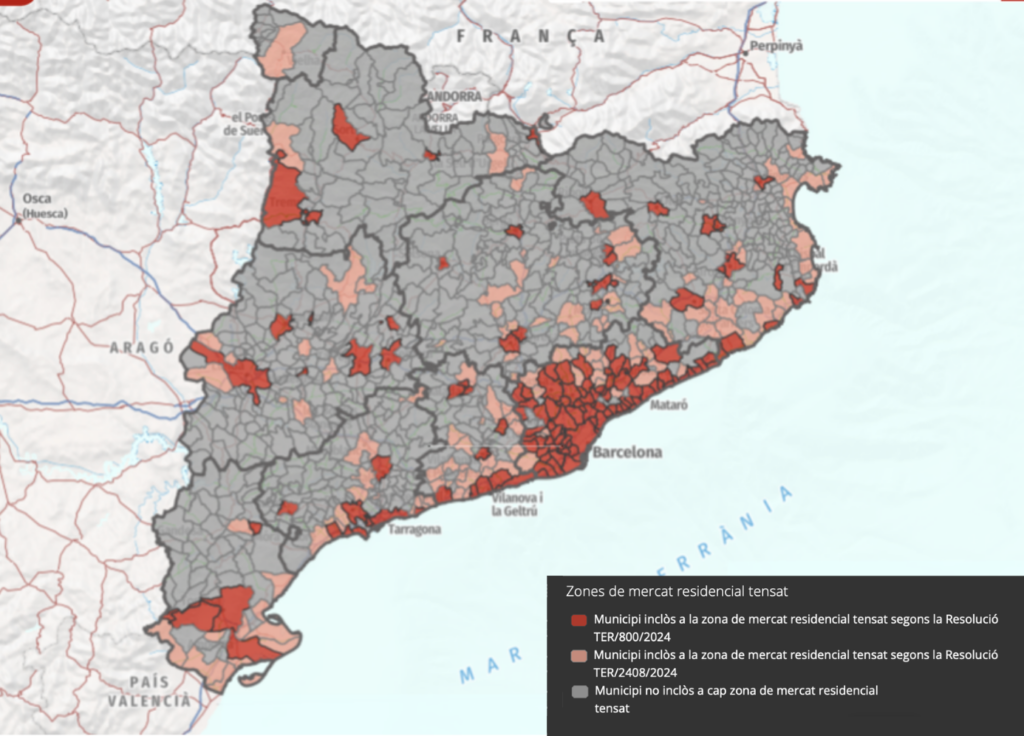
The Generalitat of Catalonia has established tensioned areas in two phases:
- First Phase (March 2024): Entered into force on 16 March 2024, affecting 140 Catalan municipalities, including Barcelona, L’Hospitalet de Llobregat, Badalona, Sabadell, Terrassa, Girona, Tarragona and Reus. These municipalities were the first to apply price limits due to the highest market pressure.
- Second Phase (October 2024): On 10 October 2024, 131 additional municipalities were included, bringing the total to 271 municipalities across Catalonia. This phase extended regulation to areas where rental prices had risen steadily, especially in coastal municipalities and inland areas with strong residential demand.
As a result, more than 80% of the Catalan population currently lives in a declared tensioned area.
Effects on rental agreements
Lease agreements signed in municipalities declared as tensioned residential market areas must comply with a maximum price set by the Rental Price Reference Index, developed by the Generalitat of Catalonia based on:
- Surface area
- Location
- Year of construction
- Property characteristics
The maximum rental price in tensioned areas depends on whether the landlord is a large property owner.
- If the landlord is a large property owner, the rent must be the lower of the following two amounts:
- The price set by the rental price reference index.
- The updated rent from the previous contract, if the dwelling has been rented within the last five years.
If the previous rent is higher than the index, the rent set by the reference index must be applied.
If the dwelling has not had a rental contract in the last five years, the rent will be determined exclusively according to the reference index.
- If the landlord is not a large property owner, the rent must be set according to the previous contract rent in force during the last five years.
- If the reference index sets a lower rent, the landlord may voluntarily (not obligatorily) choose to apply the index price.
- If no rental contract has been in force in the last five years, the price will also be set according to the reference index.
The price range established by the reference index can be consulted on the official State platform, through the Rental Price Reference Index.
Obligation to register in the large property owners registry of Catalonia
Large property owners are required to register in the Large Property Owners Registry of the Generalitat of Catalonia, indicating the total number of dwellings they own, including those corresponding to them as members of communities of property. Failure to comply constitutes an administrative offence, punishable by fines ranging from €9,001 to €90,000, depending on the severity.
Currently, the regulation formally governing registration has not yet been approved. Until it enters into force, large property owners must notify the Catalan Housing Agency of their status, also indicating the number of dwellings they own.
Once the regulation is approved, it will be mandatory to apply for registration in accordance with Additional Provision 27 of Law 18/2007, of 28 September, on the right to housing.
In summary
Catalonia is experiencing a profound shift in housing policy. The regulation of tensioned areas and the definition of large property owners aim to balance the rental market, ensuring fairer prices and responsible use of the housing stock.
Their success will depend on effective implementation combining control, transparency and sufficient supply, without jeopardising access to housing.

Contactar
Contáctanos para solicitar información sobre temas relacionados con Real estate law